

A Tai Chi form is a system of movements, interlinked seamlessly to form a dance. Its length has 3 variations; 24 movements set is referred as the ‘short’ form, 40 as the ‘mid’ form and the long form has108 movements. A standard Tai Chi form takes about 15 to 30 minutes, depending on the length and the mastery.
One aspect of Tai Chi forms is the stance. Stance is very critical to every Tai Chi form. Remember, the Tai Chi forms consist not only of the hands but the feet as well. Every Tai Chi form includes every limb and utilizes every muscle. Proper stancing is so important to Tai Chi that without it, learning the Tai Chi forms would be useless.
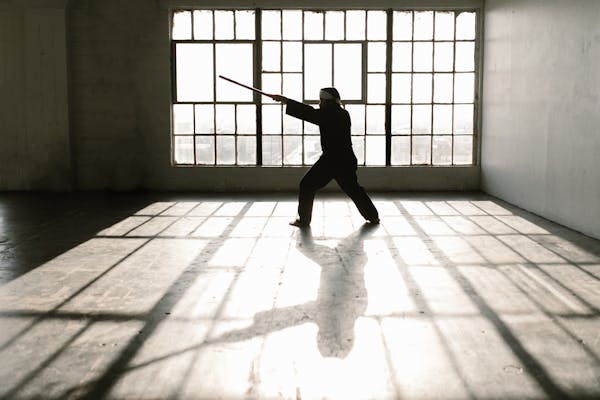
Horseback Riding stance
This is the most basic of all stances. Most martial arts have this or a variation of this stance. The Horseback riding stance lowers the body’s center of gravity, and braces the legs for stability. That’s why this is often used for meditation, because even with the eyes closed, maintaining balance is still very much attainable.
To do a horseback riding stance, stand with the back straight. Now space the feet apart around half a yard then slowly bend the legs until it reaches 90°. Curl your hands into a fist and fold the arms around the sides of the body. This will place a great strain on the legs and taut you torso muscles.
This is the opening stance for most Tai Chi forms. The stance just offers so many options for opening an attack but yet maintains a degree for defensive. See how Bruce Lee does a nunchucks exhibition? He does it with the Horseback riding stance.
As a practitioner of the art, I could never stress the importance of this stance to a Tai Form. Learn this stance before learning the Tai Chi forms. Master this stance before learning the other stances.
False Leg stance
This stance has become a standard stance for the new advent of martial arts, but the root of this stance is Tai Chi. This is an offensive stance, used particularly in junction with the Bow and Arrow stance. Kick boxers often uses this stance, since it readies their legs for an offensive kick.
To do a False Leg stance, begin by standing straight. Now, imagine an enemy 45º to your right. Take a step with your right foot towards the imaginary enemy, but instead of putting weight on this foot, transfer all your body weight to the left foot. To help you achieve this, elevate your right heel and bend your left leg to ease the maintaining of balance. Now the stance should look like a half step except you’re leaning all weight with the left leg. Raise your hands with slightly forward with palms slightly facing the enemy. Remember, don’t put pressure on the right leg; use it just to maintain balance.
Bow and Arrow stance
Like the False Leg, this is primarily an offensive stance. But there are other versions where it is used as an evasion, like the ‘leaning’ technique of Kung Fu. This is often used injunction with the False Leg stance.
To do a Bow and Arrow stance, start by doing the False Leg (assuming you can do this correctly now). Now, with your right feet, make a large step towards the imaginary enemy. If you’re doing this correctly, your right foot should now be bearing most of your weight, with your left leg slanted from its original position. Your right leg should be bended at a 90° angle.
Tai Chi Exercises
Summary: Tai Chi exercises have been taught as a health regimen. Here are some examples of these exercises.
Nowadays, Tai Chi exercises have been taught more for its therapeutic purposes. While some enjoyed meditating with Tai Chi, others had their Tai Chi as a compliment for their dancing which is much like a dance in ballet. The Tai Chi exercises are executed slowly, a series of slow dance steps, and could require a substantial amount of effort, physical and mental. That is the main reason Tai Chi exercises are highly regarded since it harmonizes the coordination of body and the mind.
Chi Exercise
One example of the Tai Chi exercises is the art of breathing. ‘Chi’ is used instead of ‘Qi’, since the Chi spelling is more widely known. This exercise is meant to be done meditatively, but is not required for one to enter into some kind of trance. The exercise is started by assuming the ‘Horseback riding’ stance. To start, stand with the back straight with the chin held levelly. Space both feet about three feet apart and slowly bend legs until it is reaches 90° at maximum. This would place a great strain in the legs, but if you are in a meditation or just closing your eyes, this stance has the best balance equilibrium. Now, hold both arms forward straight and exhale deeply and slowly, but not forcefully. This action should take out every minute air inside your lungs. Now, pull your hands slowly toward your chest turning your palms slightly inward so at the end of the process, you are holding your hands near your chest with the palms facing inward. Inhale deeply and slowly.
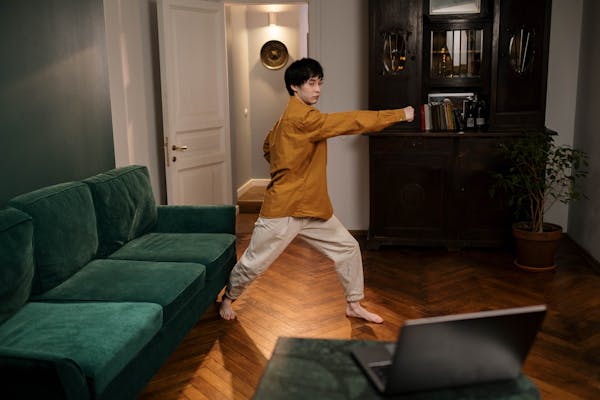
This Tai Chi exercise has found some good uses. Actually, when I studied Kung Fu, it was the first of those self practices that I was told to master. For me, it has many uses. Before, I used it to condition myself before classes; now, I use it to relax or prepare myself for something, like going for an interview. This exercise is really a good cardiovascular practice, too. When you inhale deeply and slowly, 100% of your lungs get filled, by slowly dispelling all the air in your lungs, you could also exhale all those bad elements still lodged in your lungs. But if you’re expecting this exercise to clear your carcinogen-filled lungs, please don’t expect too much.
The grinding corn exercise
The grinding corn exercise is one of the popular Tai Chi exercises practiced by monks for warm-up and for meditation. To do a grinding corn exercise, start by assuming a horseback riding stance. Keeping your stance low, reach out in the imaginary space in front of you and move your hands in a circular horizontal motion, as if a stone table were present and you are grinding corn pellets with bricks in your hand. Do the circular motions slowly and alternate the circles in your hand to create a rhythm.
As with every horseback riding stance, the weight will be felt on the thighs, but the distribution of force would make every muscle in your body tighten to support the entire body. Holding weights while doing a circular motion would also help, as it would produce a greater tension on your muscles.


0 Comments